

On stage at Money20/20 in Las Vegas, World co-founder Alex Blania unveiled World ID for banking and finance. The suite of technologies is now available to help enable AI-safe experiences for banking and financial institutions across internal and customer-facing systems, including interactions involving AI agents.
With World ID for banking and finance, organizations can have greater assurance that transactions, trades, customer requests, and even important video communications are AI-safe. The offering is backed by verifiable cryptographic Proofs such as Proof of Human, Proof of Presence, and Proof of Attributes. Bain Capital, OpenExchange, Outtake, Pantera Capital, and VanEck Funds are initial design partners utilizing the technology.
Proof of Human as essential infrastructure for the AI era
The internet, and many of the services it powers, was built on the assumption that humans would interact with other humans. Abundant and autonomous AI agents that can shop, transact, communicate, create, and ultimately outnumber humans online are now challenging this assumption. Today, trust is becoming the internet’s scarcest resource and most valuable commodity.
How AI is changing fraud in banking and finance
Enabling AI-safe experiences is particularly essential in the banking and finance industries where AI is being used to produce synthetic media and deepfakes convincing enough to trick the most advanced systems into approving transactions. More recently, the onslaught of personal agents from frontier AI organizations is opening up a new array of questions, challenges, and opportunities for consumers and financial institutions alike.
These risks are particularly significant in banking, asset management, and other financial services, where digital interactions can involve sensitive information and consequential financial decisions.
In early 2024, an employee at engineering firm Arup wired approximately $25.6 million after a video conference in which every other participant was a deepfake. Later that year, the U.S. Treasury’s Financial Crimes Enforcement Network warned that criminals were using deepfake photos and videos to get past checks on new-account applications.
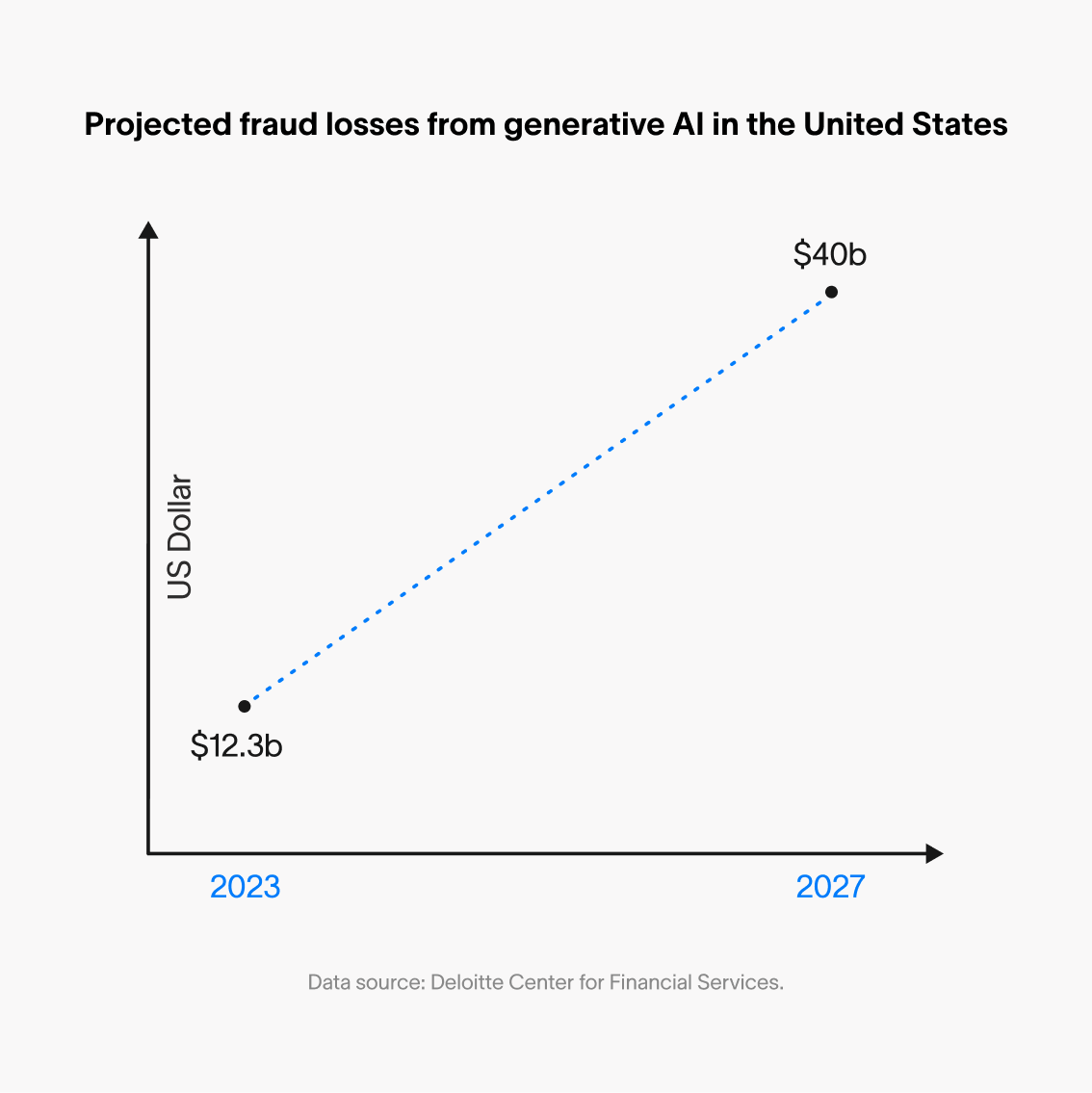
Deloitte predicts that AI-enabled fraud losses in the U.S. could reach $40 billion by 2027, up from an estimated $12.3 billion in 2023.
Financial and banking institutions face growing pressure to confirm who is behind sensitive interactions while limiting the personal data they collect and store. World ID can help them address both needs.
World ID for banking and finance
World ID for banking and finance aims to provide organizations with quantum-secure ways to establish important facts about the people behind digital interactions, both internally and externally, without collecting more personal information to store and secure. Depending on the use case, that can include whether someone is a unique human, whether they are present in the moment, or specific attributes such as age or nationality.
World ID for banking and finance brings Proof of Human to banking and financial institutions as well as their clients. Bain Capital, OpenExchange, Outtake, Pantera Capital, and VanEck Funds are design partners for the offering, which includes: World ID app, World ID for Agents, and World ID for Zoom.
World ID app: three Proofs for banking and financial services
World ID app, now available to download in the App Store and Google Play across 150+ countries, offers three types of cryptographic Proofs:
- Proof of Human establishes that someone is a real and unique human with a one-time visit to an Orb. Orbs are also currently available at the NYSE, allowing individuals to easily claim their Proof of Human.
- Proof of Presence provides a quick liveness check on a phone to prove that a person is present.
- Proof of Attributes confirms specific information from an official government credential, such as nationality or being over a certain age. It reveals only the requested information.
World ID: Universal set of human Proofs for the internet.
| Proof | When to present a proof | How to claim a proof | Privacy preserving |
|---|---|---|---|
 | High stakes actions | The Orb |  |
 | Day to day actions | A selfie | |
 | Age or nationality restricted instances | Government ID | |
| Proof | ||
|---|---|---|
| | |
| When to present a proof | ||
High stakes actions | Day to day actions | Age or nationality restricted instances |
| How to claim a proof | ||
| The Orb | A selfie | Government ID |
| Privacy preserving | ||
| | |
Institutions can use these Proofs to confirm that a client or partner is a real human or to establish facts such as nationality or age without collecting documents or storing other personally identifiable information. That can happen when a client walks into a branch, transfers a significant sum of money, or opens a new account. Organizations can deploy the technology to offer clients high-assurance banking. That includes human-binding approvals for ACH and wire transfers, and human-binding requirements for account recovery that help prevent account takeover.
How World ID works with AI agents
World ID also extends to agents through AgentKit, a suite of developer tools, currently in beta, that allows autonomous agents to use World ID Proofs. With AgentKit, a person can delegate certain Proofs to an agent. The agent can then transact on their behalf and prove it is acting at the behest of a real human without revealing private information about that person. AgentKit makes it easier for builders to implement Proofs delegated by humans to their agents.
As agents take on more financial tasks, delegated Proofs could become a best practice. That is especially true for financial services use cases that must meet consumer protection and other compliance requirements.
World ID for Zoom: verified humans in high-stakes meetings
World ID for Zoom is designed to protect sensitive, high-stakes conversations by proving that a real and unique human is present. The integration uses cryptography to confirm that the person behind the screen is a verified human. It then grants them a Human Badge that everyone in the meeting can see. Here's how it works:
- Verify once. A participant completes a one-time World ID verification at an Orb and connects World ID app to their Zoom account.
- Confirm in the meeting. When they join a call, World ID for Zoom uses World ID app and a live selfie to confirm that the person behind the screen matches the Orb-verified person connected to the account. Once authenticated, a Human Badge appears on their Zoom tile. Zoom does not receive any personal information during the process.
- Set the rules. Meeting hosts can soon require participants to authenticate their Proof of Presence in a Zoom waiting room before entering a meeting. Alternatively, any participant can request a verification during a call.
More than 18 million people hold a Proof of Human, the foundation of the real human network. Institutions interested in integrating World ID can contact [email protected].
Join the real human network.
Get World ID appRelated articles

Announcements ·
World ID for Zoom: Proof of Human technology for trusted video communications

Announcements ·
Muse, dots, Instinct, and the question every agent will be asked

Announcements ·
Product ·
peaqOS brings World ID to physical AI and the machine economy

Announcements ·